
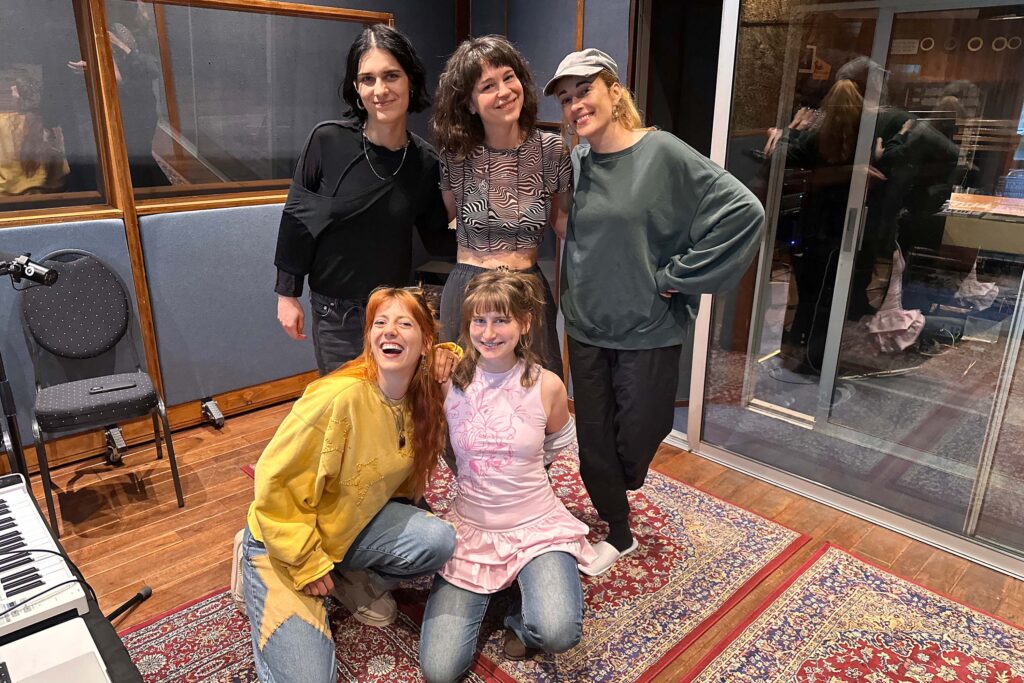
In our conversation with the participants, one thing became clear very quickly: It wasn’t just about generating output during that week in May 2026. It was also about trust, community and the feeling to be together in a room where creativity is allowed to just come into existence.
“We were working from the early morning to late at night, sometimes literally from dusk to dawn”, one of the participants remembers. Nevertheless, the residency never felt like being under pressure. On the contrary.
“It was totally open”, says Juli Lee (@itsjulilee). “There was no pressure of having to produce something. Of course we were super productive, and it wasn’t till the listening session that we really realised how much had been created. But there was no output pressure at all.” This openness seems to be the reason why so much was possible.
Five artists, one common space
The members of the team that had been put together by Helvetiarockt partly already knew each other, others met for the first time, but a connection with everyone was made pretty quickly.
Some had worked in similar constellations earlier; others experienced this kind of collaboration for the first time. This is why there was a certain element of uncertainty in the beginning: How do you write a song when there’s five of you? Who brings what ideas to the table? How far do you let others into your own creative process?
“Maybe everyone was a bit shy at the beginning”, Melicious reminisces (@melicious.mp3). “But to be honest, everyone was very professional.”
To become part of the residency, you had to apply first. “We had to write an email, explain what motivated us and also send in some of our own music”, Melicious says. “It was an online open call application.”
A joint song for Gini Brown
During the week in question, 16 songs were created. One of them was written by all of the participants together, as early as on the second day. From the first idea to a first demo version, the team only needed three hours.
All of the participants decided that with such a jointly created song, they wanted to write something for Gini Brown (@ginibrownmusic). Her sound has a clear definition, and this made it easier for the team to have a clear framework and to submerge themselves into her musical world.
The team took care to establish who could bring in what strength: Production, guitars, beat, melody, lyrics, vocals. The process remained open but not arbitrary. The team asked itself again and again: Where are we right now? What does the song need? What feels really good?
From a discussion about unusual song themes, an idea finally came about to write a song about the topic of being “hangry”, in other words, a rather well-known everyday feeling when hunger slowly tips over into irritation.
“It is something with which everyone can identify themselves,” Juli Lee says. “An everyday situation, but not a topic that has already been overstretched in many other songs.”
“It felt safe”
The atmosphere in the Powerplay Studios played an important role. Rykka (@therykka) describes that the team really felt at ease and at home: “For a whole week, they really were looking after us extremely well. We had great food, lots of help with the setting up process and really good equipment: Microphones, guitars, preamps, spaces. It was fabulous. I love the Powerplay Studios and the people here were fantastic.”
For some of the participants, writing songs together in this form was a new experience. Some write their songs on their own or just with their producer. Others are used to develop the first versions of their songs in their own space before entering a collaborative space.
During the residency, working with others was much easier because it was not necessarily about their own projects. “If the objective had been: Let us write a Melicious song, I would probably have reacted differently. But in this case, it was all about collaboration and that made it very free and fabulous.”
For Gini Brown, the situation was different because one of the songs was written for her project. “I usually write on my own, with my band or my producer”, she says. “It was therefore a completely new experience for me when the five of us wrote a song together.”
She mentions that she had been very nervous in the beginning. “I really very attached to my songs and my lyrics. To let other people into this process, can feel like you become vulnerable.” One thing that helped, though, was that the song was playful and not emotionally heavy. What really made the difference, though, was the attitude of the team: “Nobody was clutching at their own ideas. It was a rather open space. Everyone contributed something, but in a very respectful way.”
Juli Lee summarises the atmosphere with one word: “gracious” Everyone was treating everyone else in a respectful and considerate manner. “It felt safe. I usually only work with one person at a time, so this was a new situation for me. But it was a good experience. It made me curious to repeat this experience.”
More than songwriting
The residency was not just important because of the songs. The conversations between the sessions were at least as important: about fees, shows, funding opportunities, bands, difficult situations and how to navigate the music business.
“The conversations between the sessions were extremely important”, Melicious says. “Many problems in the music business come into existence because people just get thrown into this environment and do not know how to navigate it.”
Particularly the exchange with other artists who have had similar experiences or know other parts of the industry was a valuable part of the residency. You suddenly realise: This hasn’t just happened to me. Others also had to face these questions. And how much do you ask for to get paid for a gig? How do you handle conflict within the band? Where do you get support or funding?
A week with lasting echoes
The participants do not just take new songs but also new connections home. Some tracks will be refined further, and the team remains connected via chat.
Ti (@thimea1111) hopes that other collaboration projects emerge from this week: “I have the feeling that there wasn’t a single moment during the whole week where I did not feel inspired by the people with whom I worked together.” It felt like new friendships had been made there. “I would love to continue right now. We have a group chat and I hope that we continue to share ideas with one another. Some tracks are still work in progress; let’s see what becomes of them.”
Other funding programmes and networks of Helvetiarockt were mentioned in the conversations. The variety of formats connect “Finta” people, build a strong network, a kind of gang, trusted people who are there for the others.
Helvetiarockt workshops, networking formats and coaching programmes create spaces where practical questions can be asked. Questions about money, fees, funding or about working in the business. These are the topics that are often tough to tackle in everyday situations but extremely important.
Gini Brown considers them to be an important help for finding your way in the business: “Such programmes help you rather early on. They help you to navigate the jungle of the music business. You cannot just study all of this. You need spaces where you can ask questions and learn how these things work.”
Juli Lee adds that this kind of work has an effect on many levels: “Helvetiarockt offers courses and workshops but also creates awareness and builds bridges between female artists, festivals, scenes and the industry sector.”
16 songs and a feeling of community
At the end of the residency, there are not just 16 songs but also trust, new contacts, shared know-how and the experience that creativity can thrive especially when there is no pressure in the room.
Or as one of the participants summarised: “We wrote many songs but also built a lot of trust. It was productive but not because there was pressure. It was productive because the space felt safe, open and warm.” Creativity thus found its way, completely naturally.


