
It was a clear result: On 4 March 2018, 71.6% of voters and all cantons rejected the popular initiative “Yes to the abolition of radio and television licence fees (abolition of Billag fees)” – known as the No-Billag initiative. It was a clear commitment by the Swiss to the SRG SSR and the public media service. The initiative would have effectively meant the abolition of the SRG SSR, which would have gone too far for many.
Halving the SRG SSR budget
Almost exactly eight years later to the day, on 8 March 2026, SRG SSR is once again the subject of a petition for a referendum: “SRG SSR: 200 francs are enough!” (halving initiative) The proposal calls for the household fee for radio and television to be reduced from the current CHF 335 to a maximum of CHF 200 and for the corporate fee to be abolished completely. For SRG SSR, this would mean a halving of its budget and thus a significant reduction in its offering in all areas. In addition, a smaller offering would also mean a massive drop in advertising revenue. According to calculations, the SRG SSR budget would shrink to around CHF 750 million in total – less than half of the current budget.
This would mean that SRG SSR would no longer be able to fulfil its public service remit – as it is laid down today. The consequences would be fatal.
A massive withdrawal from the regions
Today, SRG SSR is present in all four language regions – with seven main locations and 17 regional studios. It reports from places where there is otherwise no media presence. With a halved budget, SRG SSR would have to centralise considerably and close many locations. The consequences would be as follows:
- less regional journalism
- less visibility for language minorities
- fewer productions on site
- fewer jobs in the regions
Cultural diversity – a hallmark of Switzerland – would be severely weakened as a result.
Less culture, less music, less film
The initiative would hit the cultural and music scene particularly hard. SRG SSR supports over 220 film projects every year, produces concerts, promotes Swiss music, offers young talent a stage and favours collaboration with independent production companies. As part of the “Pacte de l’audiovisuel”, SRG SSR financed 161 films, series and documentaries in 2024, for example.
The effects of accepting the initiative would be devastating for music creators in particular. Today, Swiss music is mainly played on SRG SSR stations, and it is these stations that offer young, less well-known artists a platform: Around 30% of the music played there comes from Switzerland: on some stations such as Radio SRF Virus, Radio Rumantsch or Radio Swiss Pop, the proportion of Swiss music is even over 40%. In comparison: The private Swiss radio stations have a total share of just under 10% Swiss music.
In addition, SRG SSR supports around 300 festivals and 600 recordings of music productions every year, ranging from brass band music, folk music and classical music to hip-hop, jazz, dance, pop and rock; SRG SSR practically covers the entire spectrum of Swiss music with its radio and TV stations.
Many careers would never have developed without SRG SSR platforms. Numerous music creators repeatedly report how crucial being on SRF, RTS, RSI or RTR was for their breakthroughs.
And as the latest figures from the Federal Statistical Office show, 80.5% of Swiss people still listen to music via radio and television, that is more than via the internet (68.3%) or free (57.2%) and paid streaming services (46.8%).
Copyright revenues would fall sharply
A further impact would be a massive reduction in revenue from copyright exploitation: In 2024, authors, producers, performers and publishers received around CHF 55 million in copyright remuneration for the use of their musical, cinematic and other works on SRG SSR channels. These revenues would also fall sharply if SRG SSR had to drastically reduce its programme offering and broadcast less music, films or series.
If the halving initiative were to be accepted, this would have serious consequences for Swiss cultural creation:
- fewer music programmes, sessions and live recordings and therefore less airplay
- less support for newcomers and discontinuation of important funding programmes for young artists
- fewer film and cultural productions
- significantly reduced visibility of Swiss art and creativity
- less revenue along the entire value chain
Today, SRG SSR is one of the strongest partners of Swiss culture. This role would hardly be possible any more if the initiative were accepted.
SRG SSR will have to make savings even if the halving initiative is rejected: The Federal Council has already announced a lowering of the fee. For households, the fee will be reduced to CHF 312 in 2027 and to CHF 300 per year from 2029. This results in savings for all private households in any case. The gradual reduction would nevertheless enable a good Service Public to be maintained and avert the cutbacks to and axing of Swiss cultural production.
Campaign by the Swiss Music Council
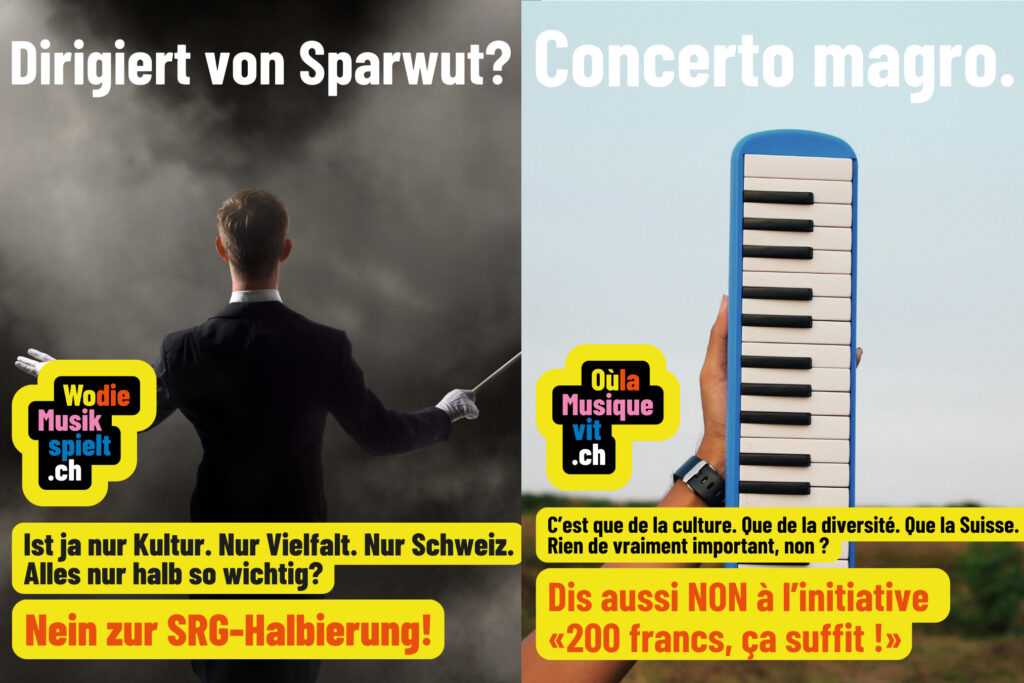
As with the No-Billag initiative, SUISA will once again campaign on behalf of its members in favour of the SRG SSR and against the halving referendum. It supports the “Where the music plays” campaign of the Swiss Music Council, the umbrella organisation for all music organisations in Switzerland. The campaign will highlight the consequences of accepting the initiative for the Swiss music industry.
This vote affects everyone who works, lives or is involved in the cultural sector. The halving initiative is not simply an austerity bill – it is an attack on cultural diversity and the democratic information base of our country. The consequences for Swiss music creation, but also for social cohesion in general, are extreme without a strong Service Public. It is paramount that they are averted for Swiss cultural creation.
Cultural professionals know how important visibility, diversity and reliable media are. They can convey this meaning authentically, be it on stage, in conversations, on social media, in clubs and communities. It is therefore important that as many artists as possible stand up for SRG SSR:
- Please speak publicly about the importance of SRG SSR for culture and music.
- Share your experiences and show what’s at stake.
- Support campaigns, initiatives and actions for a strong media system.
- Utilise your reach and your networks.
- Educate others so they know that the fees for households will be lower anyway and companies will be additionally relieved – even without the halvinginitiative.
Let’s campaign together for a No to the halving initiative. Let’s work together to prevent Switzerland’s cultural landscape from becoming impoverished. Because: A strong SRG SSR means a strong Swiss culture, also and especially with music.
The Federal Council wants to reduce the levy for households to CHF 312 from 2027 and to CHF 300 from 2029. For collective households, such as care homes, a reduction in the fee is proposed from the current CHF 670 to CHF 624 from 2027 and to CHF 600 from 2029.
Furthermore, over 60,000 companies are to be exempt from the levy from 2027. Until now, businesses with an annual turnover subject to VAT of CHF 500,000 have had to pay. In future, only companies with an annual turnover of CHF 1.2 million will have to pay. This would mean that around 80 per cent of companies will be exempt from the fee.


