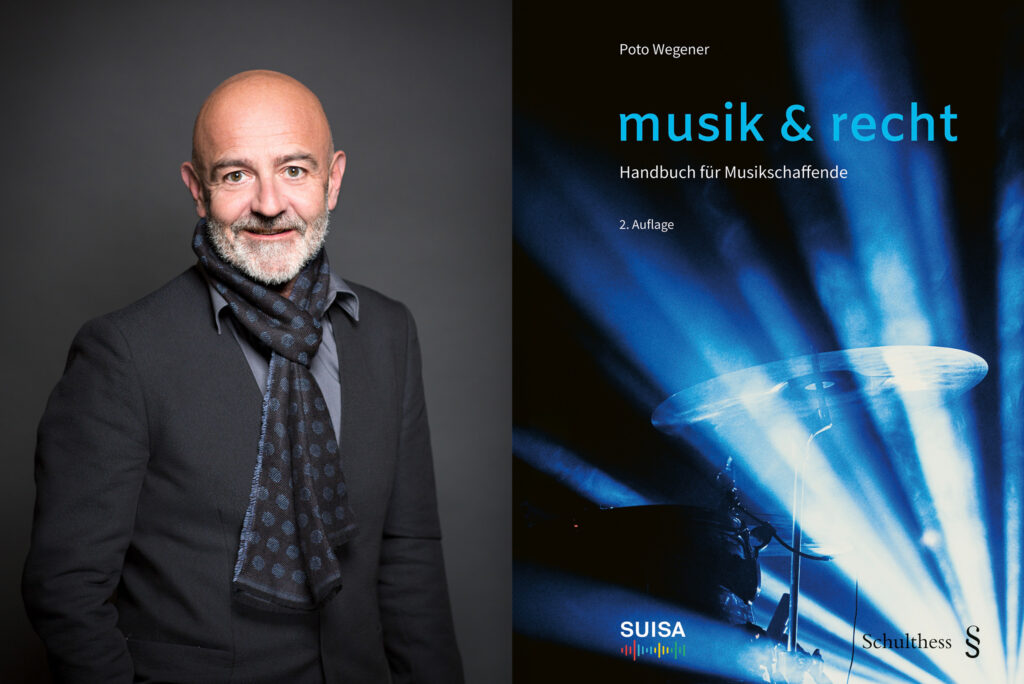
Federal Councillor, Beat Jans, wrote the foreword to Poto Wegener’s new edition of “musik & recht” and put the key points of this topic in a nutshell. As a young music creator, he played in various bands, and even toured Ireland with the band “the Wimps”. At the time, he did not think about legal aspects of music but got a feeling for the amount of spirit, creativity, work and passion went into music. And that all of that had to be protected. Today, as a Minister of Justice, I know: If you make music, you will have legal questions one day.”
Poto, the history of music is full of young music creators who are fully focussing on music and who did not really face legal issues when the first successes were kicking in, until some day they came back down to earth, or legal reality. Is this still the case in your experience?
Poto Wegener: Unfortunately, yes. I experienced this myself when I was a musician back in the day. I signed contracts that I would no longer sign today. As a lecturer in various music collegues and universities I know that music law and music business are now taught there. I believe, however, that such topics should be of even more significance because music creators should be informed about their rights as a basic principle, and should be particularly informed about how they can make money. Making music is, if it is supposed to be done professionally, a job like any other. And that is where you need the legal and economic toolbox to be able to stand out.
Many musicians say that such legal questions would only become important once a certain level of success kicked in…
Of course, if you only make music as a pure hobby, then legal questions do not reach the same level of significance. But the transition from a hobby musician to a professional musician is often done more quickly than you would think. And if you are then asked in those periods to also take care of the legal matters, it may well be too late. Alternatively, you can hire a manager who is well-versed in such things. But even then, a certain basic level of know-how is useful for music creators so that they can actually carry out some kind of controlling of their partner.
Some knowledge is probably also important within the band…
Many people think that there is a lot of plagiarism in the music world. In practice, it happens more often that band members quarrel sooner or later who should get which shares in a work.
Establishing a fair distribution key is difficult. Questions arising from that such as whether the drummer gets the right to a share in the lyrics because he provided a keyword for the topic of the refrain can neither be answered by a lawyer nor a book…
No, but a lawyer can advise. And a part of the book covers how a music band can organise itself in terms of the law. The most important note: Legally speaking, a band is automatically a einfache Gesellschaft [partnership]. This means that you are liable for debts jointly and severally and to an unlimited extent; most of the time, the band members are not aware of this. It is therefore recommended to conclude a contract within the band in order to discuss such questions up front. By doing so, you may find problems that you could actually encounter later. This is sensible even in case that these problems do not pop up later.
You had your own experience as a music creator in the music business, and probably not just good ones. Were they the reason that you became a lawyer?
My motivation was actually another one. Yes, I did actually “put all my eggs in the music basket” when I was young: Not only did I make music myself, I also organised concerts, worked a little for the then radio station DRS3 and wrote articles about music for the Basler Zeitung [Basel newspaper], and founded a label. And at some point I realised that I was probably not good enough as a music creator to be able to earn enough for a living later in life.
At the same time I also was lucky enough that I often was at loggerheads with my then landlord. I had to appeal to the tenant mediation board or the courts of law seven times and once he took a lawyer, and so did I. So, two lawyers fought about this tenancy issue. And I thought that this could not be it. As a consequence, I made it a goal of mine that I would no longer have to take legal representation through a lawyer. I then started to read up on tenancy law and thought at some point, why not study law? I did it, and really enjoyed it.
At the end of my studies, I met Bernhard Wittweiler, former head of the SUISA Legal Department, during a presentation in Basel. I asked him whether he had any vacancies there. And this is how I went to my job interview and I got the job. This provided me with access to music law. On top of that, I lectured music law and music business at the jazz school Basel at the time. I wrote a script for the students which got longer and more exhaustive each time. At some point I thought, why not make a book out of this. And this is how the first edition of “musik & recht” was created in 2003.
23 years later, you wrote in the intro of your current new edition: “May this book support the outstanding Swiss music scene to become even more professional and contribute to fairplay in the business” From your own experience at SUISA and SWISSPERFORM, has the music scene become more professional in terms of the legal aspects since your time as a musician and also since the first edition of this book?
Yes, I really believe that the professional environment is looking more after the rights which is of course a positive development. There are a variety of reasons for this progress, maybe just because there are significantly more people today that are making music. In order to stand out you have to become more professional.
What made you revise the book, already regarded as reference literature, and despite the advanced professionalisation of the music business, in such an extensive manner?
I believe that there is a continued need for answers when it comes to legal questions and for contacts where you can get advice. The first edition dates back to 2003, a lot has changed since then, and people kept asking for a revised edition time and again. Apart from the job at SUISA and then SWISSPERFORM I did not have the time to revise the book in a proper manner. Two years ago, I finally had the time to do this, and I also had enough energy and passion to do it. And, indeed, I really enjoyed doing this.
That is surprising if you take into consideration that this is a rather abstract and dry subject matter. The advantage was probably that you were able to rely on a rather solid basis…
Exactly. If I had had to write the book without any starting point, I would probably still be writing it. I was able to build upon the existing material, step by step, and knew also which areas had been subject to major changes which raised additional questions.
In the 23 years since the first edition, technical features and opportunities in the music arena, hashtag digitisation, and therefore also the music industry itself changed massively, just think of streaming which was only a side effect back then and yet, you had mentioned it in your book even then. In the last few years, the new possibilities of the rapidly evolving AI led to a massive technical shift, and the legal environment is hardly able to keep up with it…
This is the case, and has been the case in the history of copyright time and again. Take the invention of the phonograph, or the introduction of radio in Switzerland about 100 years ago, for example. They were technical developments that were implemented without waiting for any legal steps to be adapted accordingly. They only became necessary as a consequence. Before radio came into being, there was no broadcasting right for creators or artists and labels. That means that after the invention of e.g. MP3 or using AI in music production, there is always a certain period where music rights are used without licences and without payment, something that always shakes the music business. This leads to the need for adaptation because the purpose of copyright is to create a balance of interests between the users and the rightsholders. The users want to have a rather cheap access to art and the rightsholders want protection and remuneration. As soon as there is an imbalance, the law has to be amended.
Which sections are the most revised in the book, and which topics are completely new?
Well, in the first edition, there was a chapter called “music & internet” and that, of course, is the area that has undergone the most change. I have also put updates in other chapters where the law has not undergone as much change, for example when it comes to the international outlook in terms of copyright or the topic of authorisations for arrangements. There are also chapters where there was surprisingly little change apart from the figures, and others are completely new such as “music & digitisation”.
Due to the advent of AI, a lot of grey areas popped up: Is a work protected by copyright if it has been created with the aid of AI? How far has this been resolved or how far behind is legislation in this respect?
When it comes to AI, we can expect that a draft of the IPI (Swiss Federal Institute of Intellectual Property) is presented which probably defines that the use of musical works in the AI arena is also considered a use that affects the rights of creators and artists. This would mean that the use for training purposes must be licensed which in turn would imply that a licence fee can be levied for that. The results of generative AI usages, the output, are not new works since they have not been created by a person. This means that the creations are not protected but at the same time, every AI output creates a competitive product to the human-made works and leads to the creators of the latter receiving less income. This problem is of course different from music genre to music genre, it is unlikely that it will affect folklore and heavy metal as much as “normal” pop music.
The new edition of “musik & recht” has more than 1,000 pages and is thus nearly twice as long as the old one. What is the reason for that?
It is clearly more comprehensive in terms of subjects, it has new chapters such as “synchronisation rights” and “music in games”, it also includes new model agreements. I have also brought new aspects on board, such as in the chapter on the right to receive remuneration, which now includes tariffs and a customer perspective. Another thing I would like to add is: The book has more than 1,000 pages and I do not believe a single person who tells me in a year’s time that they have read the entire book. It is a book that you have on your book shelf or on your computer and you can check out the table of contents and quickly consult the topics in the index. Of course it also means that there are some repetitions. If you find the definition of a producer of a sound recording in the chapter on the sound recording industry, then you will find this in a shorter version elsewhere so that you understand the background in the respective section.
The index was improved by providing cross references to other chapters to make it more practice oriented. Do these cross references also indicate that the legal situation in the music environment has become more complex?
Yes it has a certain complexity in general, simply because of the fact that the rights are fragmented. You have the copyright that affects the work and then you have the neighbouring rights that affect the recording of the work, and both rights affect different rightsholders. And here I still notice that people who have been in the business for many years still do not distinguish enough between the two. It is part of the basic configuration of music rights that you must keep those two legal areas apart. This could be especially tricky for people who want to licence music because they do not just have to clear the copyright but also the neighbouring rights. It was quite a problem in the case of The Verve when they used a sample in the piece “Bitter Sweet Symphony” and that had far-reaching consequences.
The problem of many creators is that they are not able to afford an experienced manager or even a lawyer when they are at the beginning of their career. This is why I am asking the question: Will this book also be accessible to people who have no legal background?
Put it this way: This book will also be accessible to people who have no legal background if they really want to, even though music right is no simple matter and the mere size may be daunting. But if someone is looking for individual provisions regarding specific questions such as a concert agreement and thus tries step by step to dive into the matter, then this is something that can absolutely be done.
It probably helps that the book has a clear structure and is written in an easy-to-understand manner. It also provides a concise conclusion for all 16 chapters, ranging from copyright and the right to receive remuneration, noise control and social benefits. The many model agreements and templates are also practice-oriented: Is it allowed to use these models outright for one’s own purposes?
Yes, of course. In addition to the book, you can also purchase packages with such templates in word format: all agreements or a package for music creators and one for the music industry. I will also change these templates whenever there are legal updates so that you can always access the latest version.
So, the book does not only address music creators then…
No, I would like to reach everyone in the music business also those working in management, publishing houses, record labels and also lawyers because they may not necessarily have access to music rights.
For music creators, the book is probably particularly useful if they can check what the different provisions in a contract actually mean. But what are they supposed to do when they still have questions and something is still unclear, do they then need a laywer?
I recommend that you do not sign anything if there still is a provision in a contract you do not understand. I believe the difficulty is to define questions and remain honest with yourself. If you cannot clarify the question yourself or if you are not happy with parts of the contract and wish to negotiate then it is necessary to obtain legal advice, something which you can get from the SUISA Legal Department if you are a SUISA member, by the way.
There is the saying that being right and being granted a legal right are two different things. So, even if you have the best contract, it can be difficult to enforce it…
This is true, especially if the contracting parties are stronger or are based abroad which, depending on what country it is, can make things even trickier.
Poto Wegener
Poto Wegener (1964), from Basel, worked as a musician and concert organiser in his early years. He then studied law and worked in various positions at SUISA and SWISSPERFORM over the last 25 years. In addition, he published several books and articles on the topic “music rights”, for example a dissertation on the topic of “sound sampling” in addition to the book “musik & recht”.
The new edition of “musik & recht. Manual for music creators” is published by Schulthess publishing house Zurich, with SUISA being a cooperation partner in the project. The publication also supports SONART, music creators Switzerland, the Swiss Music Association SMV and the Conference of Swiss Universities of Music, KMHS.
SUISA members can obtain “musik & recht” and the contract templates of the book at a reduced rate online from the publisher, either as a book or in digital format. The discount code will be sent to SUISA members via mailing.